Case Study
A High-Value Manufacturer Builds a Defensible Niche in a Saturated Corporate Market
Specialization strategy and niche positioning to mitigate pricing pressure, safeguard commercial margins, and structure sustainable differentiation.
+25%
Sales growth achieved following the strategic product line launch
+60%
Increase in average order value optimized through cross-selling frameworks
Context and Challenge
The organization operated in the B2B corporate channel as a specialized manufacturer of premium modular furniture, leveraging its historical competitive advantage on technical quality, structural durability, and high-standard after-sales service.
However, market maturation and the aggressive influx of low-cost substitutes began to erode brand positioning, squeezing commercial margins and driving corporate procurement bidding processes toward a severe price war. The core issue did not stem from production capacity, but rather from the strategic focus of the product portfolio.
The central challenge required designing a structural exit from the commoditized category to halt profitability degradation and secure a highly defensible, long-term market position.
Strategic Assessment
A comprehensive commercial audit provided a clear diagnosis: competing under the existing market rules would only accelerate asset commoditization. The necessary strategic response demanded moving operations into a specialized space where the offering would no longer be directly comparable.
We identified a profound transformation in corporate office layouts: the rise of hybrid workspaces, agile methodologies, and flexible corporate environments that required immediate physical reconfigurations. The real business opportunity lay not in manufacturing more standard desks, but in providing the modular infrastructure that enabled this spatial agility before competitors could assimilate the trend.
Strategic Architecture
A specialization architecture was engineered to subvert the traditional value metrics within the category. The strategic intervention systematically aligned high-value niche mapping, functional differentiation focused on corporate space optimization, scalable manufacturing engineering, and a product portfolio structurally optimized for cross-selling.
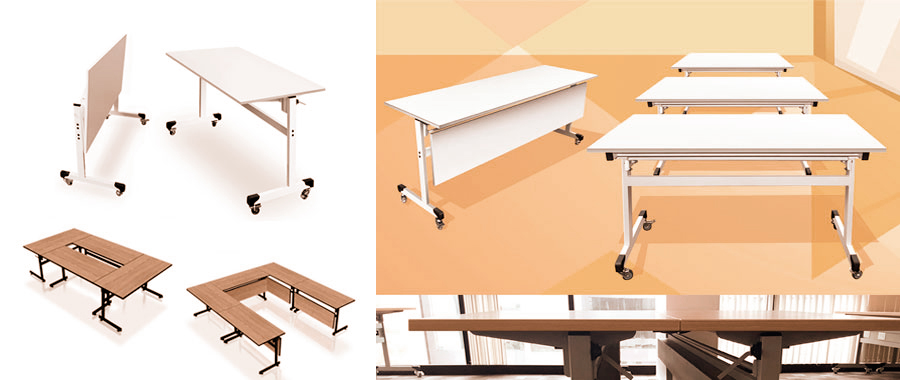
Under this conceptual framework, PleGO was developed—a line of folding tables designed as scalable modular infrastructure for corporate environments. The product was engineered based on real-world user behavior analysis, minimizing distribution logistics costs while establishing a high-performing value proposition for key corporate accounts.
Strategic Decisions
The critical business resolution was to deliberately bypass generic high-volume manufacturing and commit to a highly targeted specialization strategy within an industry obsessed with cutting production costs.
This new decision architecture enabled the company to:
- · Disconnect the brand from direct comparison against cheap corporate imports.
- · Sustain a premium pricing model justified by spatial return on investment.
- · Maximize revenue capture per square meter through structured cross-selling.
- · Build robust competitive entry barriers against traditional manufacturers.
- · Safeguard net business margins amid broader commercial market contractions.
The product line stopped being sold as mere corporate furniture and evolved into a strategic space agility solution. The organization successfully abandoned a hyper-saturated market to operate exclusively within a defensible niche where value capture responds to its own business rules.
Business Impact
+25%
Sustained sales growth achieved following the deployment of the new optimized portfolio.
+60%
Increased capital capture across key accounts driven by optimized cross-selling frameworks.
+35%
Optimization of operational profit margins and industrial manufacturing cost efficiencies.
Market consolidation within the highest-value corporate and institutional procurement segments.
* The organization successfully ceased competing within a commoditized category, establishing an exclusive space where differentiation, specialization, and value capture operate under highly profitable business rules.
SDA Takeaway
“When a market becomes commoditized, competitive advantage rarely comes from outperforming rivals within the existing framework. It emerges when strategic architecture redefines the space entirely, making the value proposition no longer comparable.”
Is your organization competing in a saturated market… or simply within a poorly defined category?
If your business needs to engineer a proprietary, highly profitable, and defensible space, it is time to redesign your strategic criteria.