Case Study
A B2B Importer Validates its Entry into the B2C Market Without Exposing Margin or Oversizing Inventory
Market validation strategy and agile deployment designed to test demand, accelerate conversion, and build direct traction with the final consumer.

70%
Of initial inventory sold out within 5 months
12%
Conversion rate from qualified leads to customers
Context and Challenges
Following a decade of solid operations as a B2B importer of specialized machinery, the company identified a commercial diversification opportunity toward the direct-to-consumer segment, driven by the increasing sophistication of home coffee culture.
The critical challenge transcended simple commercialization. The organization required a rigorous B2C market validation without possessing prior direct retail experience, mitigating operational risks such as inventory overexposure, net margin erosion, and reliance on intuitive decisions.
The strategic problem lay in engineering an efficient commercial ecosystem that would prevent premature capital injection into stock acquisition and digital ad spend, without first acquiring measurable evidence of traction and clear consumer behavioral insights.
Strategic Assessment
Entering the new channel did not require an initial massive volume or indiscriminate brand positioning. The real competitive advantage was rooted in the company's technical backing as an established importer, portfolio quality, and the ability to transfer trust within a high-ticket category where the end user actively seeks to minimize purchasing risk.
The strategic logic consisted of transforming the launch into a controlled market validation system. The sales funnel had to operate simultaneously as an optimized conversion infrastructure, a commercial learning mechanism, and an inventory control dashboard to guide future scaling decisions.
Intervention and Architecture
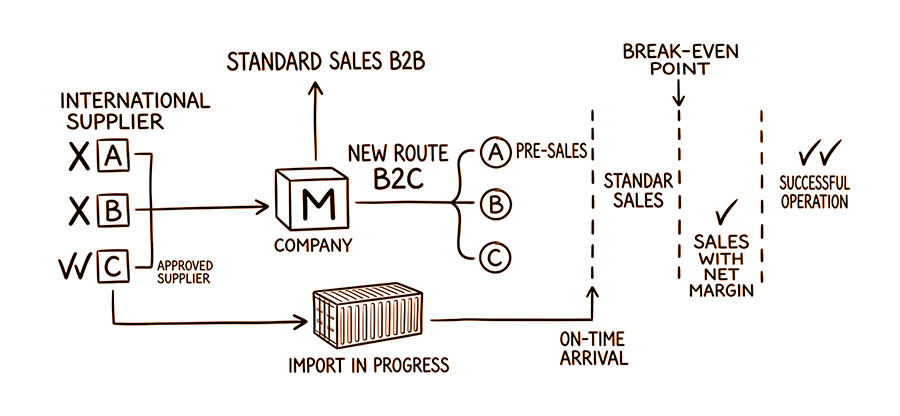
A B2C commercial decision architecture was structured, focusing on rapid demand testing and conversion efficiency prior to increasing operational cost structures. The intervention aligned audience segmentation, the value proposition, and the pricing strategy with digital acquisition tactics sharply focused on the ideal consumer profile.
The funnel design was engineered specifically to attract demand with high purchase intent, reducing friction through demonstration experiences designed to elevate average ticket sizes via cross-selling. The business objective extended beyond running marketing campaigns; it focused on building commercial certainty to mitigate operational risk.
Strategic Decisions
The core resolution was to neutralize premature expansion through rigorous inventory control and phased commercial validation. Instead of competing on volume or applying aggressive discounts that would erode brand equity, the operation prioritized the quality of the acquired customer and stock rotation velocity.
This business architecture enabled the achievement of the following milestones:
- · Moving high-density stock without degrading the brand's premium positioning.
- · Developing a direct demand channel with precision and predictability.
- · Maximizing customer lifetime value through cross-selling complementary products.
- · Generating clean business metrics and indicators to justify strategic B2C scaling.
Through this deployment, the company evolved its B2B matrix to consolidate a brand with its own commercial structure and traction across digital channels. The launch ceased to be a high-uncertainty gamble and became a system governed by strategic decisions based on real data.
Business Impact
70%
Controlled stock turnover and liquidation of initial inventory within the first 5 months.
12%
Conversion rate achieved on qualified leads, optimizing the efficiency of commercial channels.
+20%
Capture of additional value and contribution margin per customer through cross-selling strategies.
+18%
Increase in average ticket size and optimization of revenue per commercial transaction.
Establishment of a profitable B2C channel with solid positioning and predictable market data.
* The organization successfully validated its strategic transition to the B2C market, consolidating a direct channel with its own commercial traction, greater inventory control, and reduced dependence on traditional distribution networks.
SDA Takeaway
“When customer acquisition, conversion, and inventory control are synchronized under a single decision architecture, commercial launches abandon uncertainty to transform into systems of controlled, profitable growth.”
Do you need to validate demand, launch a product, or open a new channel without increasing unnecessary risk?
Let us structure a commercial decision architecture that minimizes operational risk and converts raw data into real traction.